PET FEEDING · 5 MIN READ
How Much to Feed Your Pet: Calorie Needs by Size and Life Stage
Pet food bag instructions are usually wrong for your specific pet. Here is the simple veterinary formula for calculating actual calorie needs, plus the lifestyle and life-stage multipliers that get you to the right portion size.
Advertisement
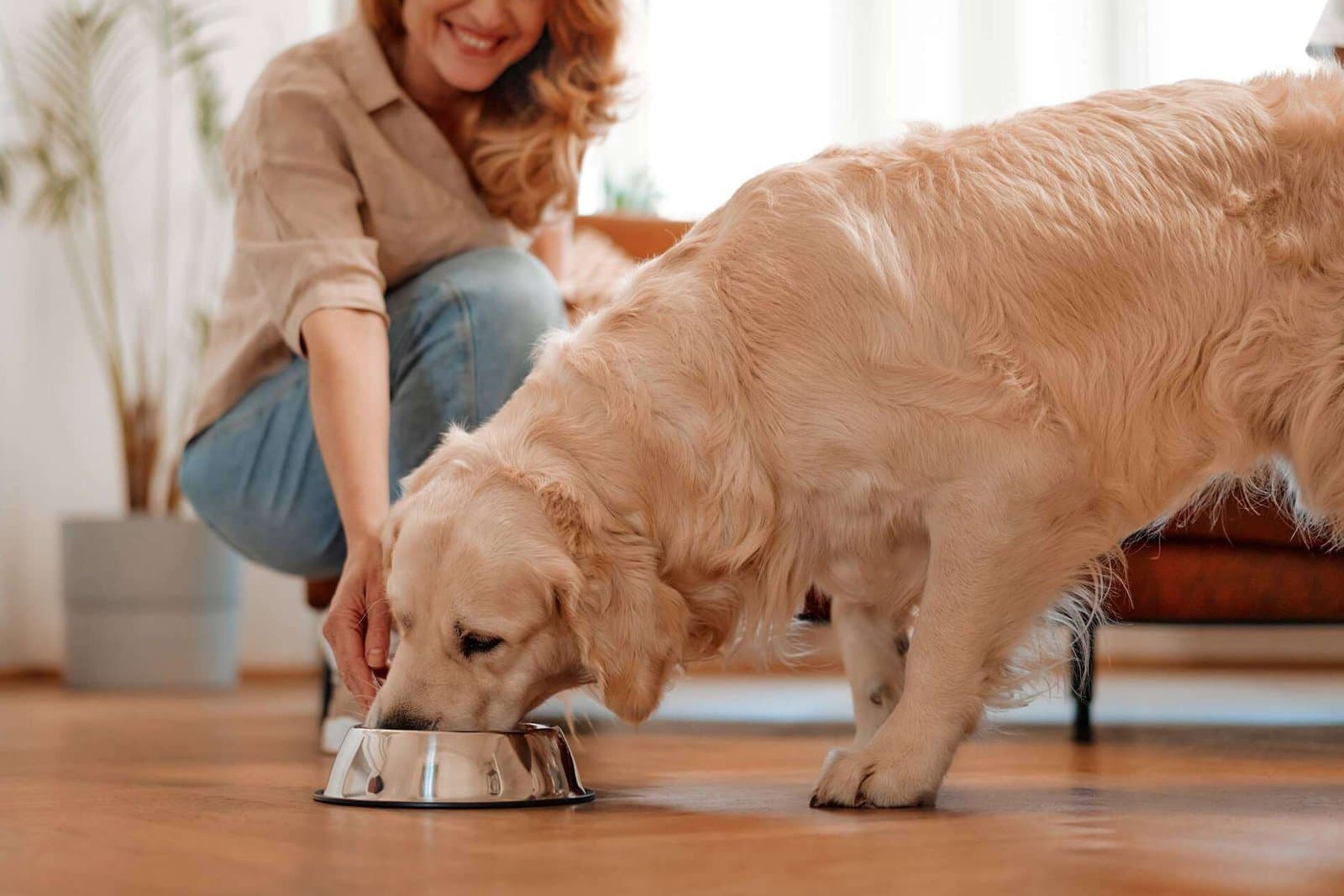
Why Bag Instructions Are Usually Wrong
Pet food bags list feeding guidelines based on average pets at average activity levels. The averages are usually pegged to active intact adult animals — but most pet dogs are spayed/neutered, less active than the assumed baseline, and live indoors. The result: most owners following bag instructions exactly are overfeeding by 20-30%.
That gap is one major reason 59% of U.S. dogs and 61% of U.S. cats are now overweight or obese. The fix is not guesswork — there is a simple veterinary calculation that produces a much more accurate target.
The Math: RER and DER
Veterinarians calculate calorie needs in two steps.
Step 1: Resting Energy Requirement (RER)
RER is the calories your pet needs while at rest at a comfortable temperature — basically the metabolic baseline. The standard formula:
RER = 70 × (body weight in kg)0.75
For pets between 4 and 100 lb (2-45 kg), a simpler version works just as well:
RER = (30 × body weight in kg) + 70
To convert lb to kg: divide by 2.2.
Step 2: Daily Energy Requirement (DER)
DER is what your pet actually needs over a full day. It is RER multiplied by a life-stage and activity factor:
| Life stage / Activity | Multiplier |
|---|---|
| Inactive / weight loss (dogs) | 1.0 × RER |
| Spayed/neutered adult dog | 1.6 × RER |
| Intact adult dog | 1.8 × RER |
| Active adult dog | 2.0-3.0 × RER |
| Puppy 0-4 months | 3.0 × RER |
| Puppy 4-12 months | 2.0 × RER |
| Senior dog | 1.2-1.4 × RER |
| Spayed/neutered indoor cat | 1.2 × RER |
| Intact adult cat | 1.4 × RER |
| Kitten | 2.5 × RER |
| Cat weight loss target | 0.8 × RER |
Multipliers consistent with the AAHA Weight Management Guidelines.
A Worked Example
A 25 lb spayed adult dog (about 11.4 kg):
- Convert: 25 ÷ 2.2 = 11.4 kg
- Calculate RER: (30 × 11.4) + 70 = 412 calories
- Multiply by activity factor (1.6 for spayed adult): 412 × 1.6 = 660 calories per day
If a typical kibble has 400 calories per cup, this dog needs about 1.65 cups per day, split into two meals. Bag instructions for the same dog often suggest 2-2.5 cups — significantly more than required.
Adjusting From the Calculation
The calculation gets you to the right starting point, but every pet is an individual. Adjust based on:
- Body condition score. If your pet is gaining weight on the calculated amount, reduce by 10% and recheck after a month. If losing weight unintentionally, increase by 10%.
- Real activity. A dog who actually does 2 hours of off-leash exercise needs more than the spayed-adult multiplier suggests; a couch-bound dog needs less.
- Treats. Treats should be 10% or less of total daily calories. If you give significant treats, reduce kibble portions accordingly.
- Life stage transitions. Calorie needs drop sharply after spay/neuter (often 25-30%) and again at senior age (often 10-20%).
How to Measure Accurately
- Use a kitchen scale. Pet food labels list calories per cup, but actual cup measurements vary by 10-25%. Weighing food in grams is far more accurate.
- If using a measuring cup, level it. Heaping vs leveled cups can differ by 30-40 grams.
- Calculate calories per gram. Look on the bag for kcal/kg — divide by 1000 to get kcal/g. Multiply by your scale weight.
Special Cases
Puppies and kittens
Growth requires more calories than maintenance. The RER × multiplier formula above works, but young puppies (0-4 months) need 3-4 × RER. Large-breed puppies have additional considerations to prevent rapid growth that increases orthopedic disease risk; their portions should be measured carefully.
Pregnant and nursing pets
Calorie needs can double or triple during peak lactation. Free-feeding a high-quality growth or all-life-stages food during this period is usually appropriate. Consult your vet for individualized recommendations.
Working dogs
Sled dogs, hunting dogs, search-and-rescue dogs, and other actively working animals can need 2.5-5 × RER. Most pet active dogs are not in this category despite owners' perceptions.
Cats specifically
Most adult cats need 200-300 calories per day — much less than owners typically guess. Indoor spayed cats are particularly easy to overfeed. A 10 lb (4.5 kg) cat needs roughly:
- RER: (30 × 4.5) + 70 = 205 calories
- DER: 205 × 1.2 = 245 calories per day
The Treat Math
Treats should not exceed 10% of daily calories. For the 25 lb dog above (660 calories total), that is 66 calories of treats per day. Many commercial treats are 30-50 calories each, so 1-2 treats per day is the realistic limit.
A common mistake: feeding a full meal portion plus generous treats. The arithmetic does not work, and weight gain is the result.
When the Calculation Does Not Match Reality
If your pet is at the right calorie target but losing or gaining weight unexpectedly:
- Recheck for medical issues — hypothyroidism in dogs, hyperthyroidism in cats, diabetes, and Cushing's disease all affect weight.
- Check who else feeds the pet. A spouse who just gives a little can add hundreds of weekly calories.
- Confirm the food's actual calorie content. Some light or weight management foods are barely lower than standard formulations.
- Reassess activity level honestly. A daily walk is not the same as 30 minutes of off-leash running.
Quick Reference: Common Pet Sizes
For owners who want a starting target without doing the math, here are typical daily calorie ranges for common pet sizes (assuming spayed/neutered, indoor, moderate activity). Round generously as starting points; adjust based on body condition.
| Pet | Weight | Daily calories |
|---|---|---|
| Small dog | 10 lb | 275-350 |
| Small dog | 20 lb | 440-550 |
| Medium dog | 40 lb | 770-960 |
| Large dog | 60 lb | 1000-1300 |
| Large dog | 80 lb | 1300-1700 |
| Giant breed | 100+ lb | 1600-2200 |
| Cat | 8 lb | 200-260 |
| Cat | 12 lb | 270-340 |
If your pet is overweight, target the lower end of the range. If actively losing weight, your vet can calculate based on target weight, not current weight.
Free Calculators
If the math above feels off-putting or you want to double-check your numbers, multiple free veterinary calculators will do the calculation for you. The Pet Nutrition Alliance and several veterinary teaching hospitals publish online RER/DER tools where you enter your pet's weight, life stage, and activity level. The output is the same as the manual calculation but takes 30 seconds.
Whichever method you use to arrive at it, the resulting calorie target is a starting point — not a permanent prescription that never needs revisiting. Recheck against actual body condition every 4-6 weeks during weight management, every 2-3 months during stable maintenance.
The Bottom Line
The calorie calculation produces a starting target that is usually 20-30% lower than bag instructions — and significantly more accurate for the average spayed/neutered indoor pet. Combine the calculation with monthly weight checks and a body condition assessment, and you have the data to keep your pet at ideal weight for life. Working with these numbers is the single most impactful nutritional habit most owners can build, and it pays dividends across the pet's entire lifespan in the form of better weight, fewer obesity-related health problems, and a longer healthy life.
This article is for informational purposes and is not veterinary nutrition advice. For specific dietary recommendations for your pet, consult your veterinarian or a board-certified veterinary nutritionist (DACVN).
RELATED READING
More from Pet Feeding
Pet Feeding
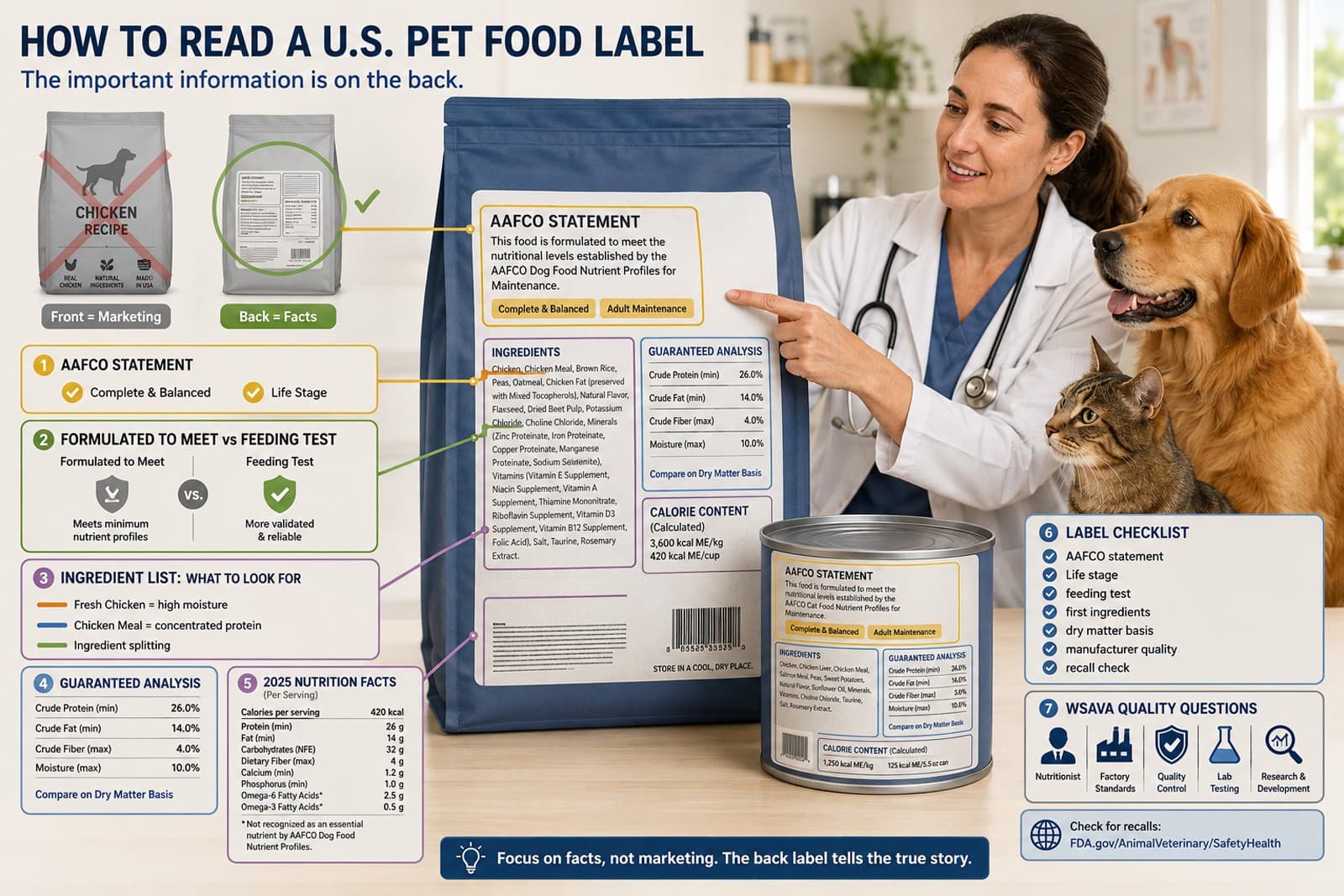
How to Read a Pet Food Label
Pet food labels are dense, regulated documents that contain almost everything you need to know about a product — if you understand the code. Here is how to decode the AAFCO statement, ingredient list, guaranteed analysis, and the new 2025 Nutrition Facts panel.
2026-05-08
Pet Feeding
The Grain-Free Pet Food and DCM Question (2026 Update)
In 2018 the FDA flagged a possible link between grain-free diets and a heart condition called dilated cardiomyopathy in dogs. Eight years later, the science is still incomplete and the recommendations are nuanced. Here is what we actually know — and when grain-free still makes sense.
2026-05-07
Pet Feeding
Wet vs Dry Pet Food: What the Science Actually Says
The wet vs dry food debate is more nuanced than most marketing suggests. Here is what the moisture content data, urinary health research, dental claims, and cost analysis actually show — and why mixed feeding often makes the most sense.
2026-05-05