PET FEEDING · 6 MIN READ
How to Read a Pet Food Label
Pet food labels are dense, regulated documents that contain almost everything you need to know about a product — if you understand the code. Here is how to decode the AAFCO statement, ingredient list, guaranteed analysis, and the new 2025 Nutrition Facts panel.
Advertisement
Why Labels Matter
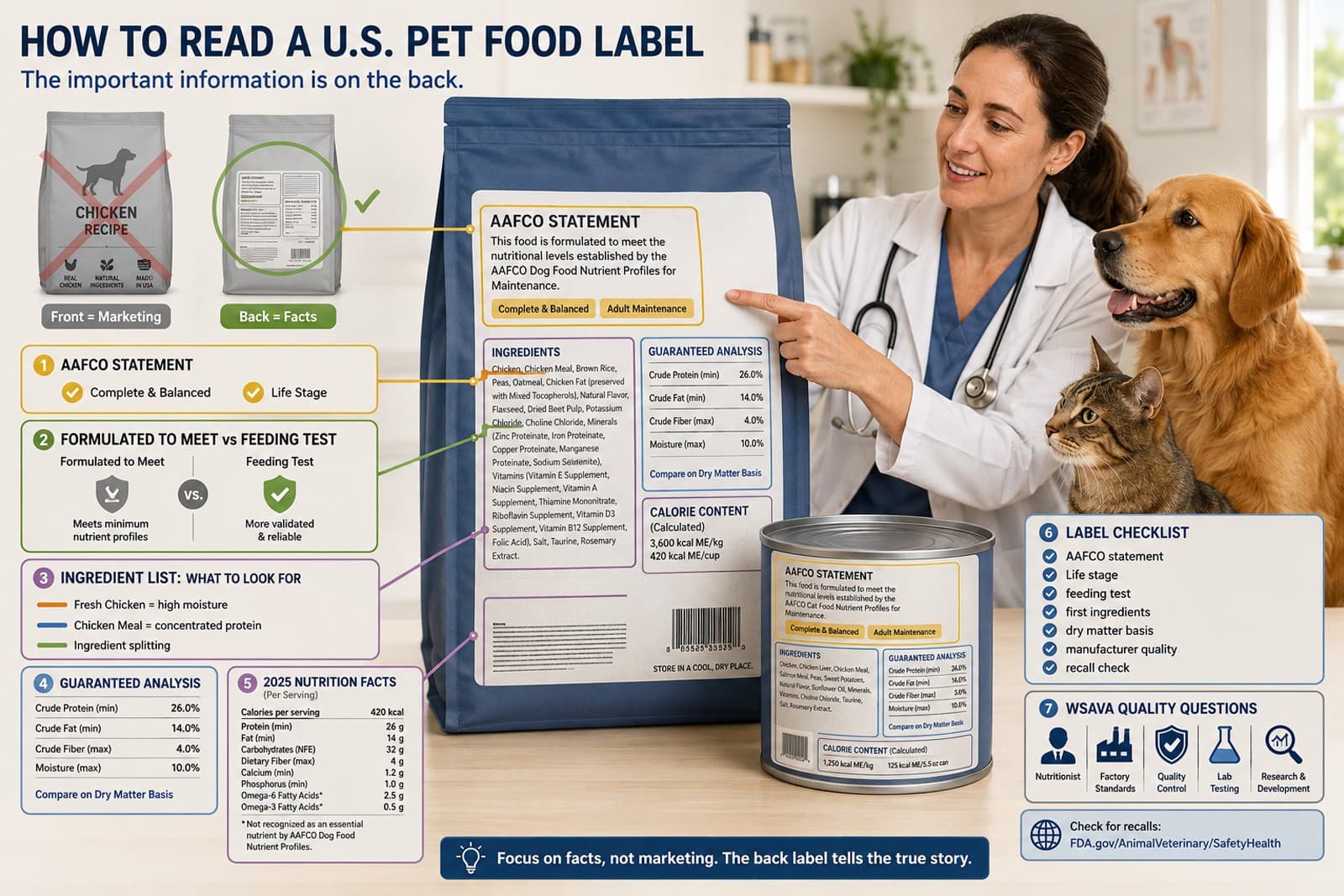
U.S. pet food is regulated by a combination of the FDA, individual state feed control officials, and the Association of American Feed Control Officials (AAFCO). The labels you see on every commercial pet food in the United States follow a standardized format set by these bodies. Most owners glance at the front of the bag and ignore the rest. The most important information is on the back.
This guide walks through every part of a U.S. pet food label, what to look for, what is marketing, and what the new 2025 Nutrition Facts-style panel means for the way you compare foods.
The AAFCO Nutritional Adequacy Statement (The Most Important Line)
Find this on the back or side of the bag. It looks something like:
Brand X Adult Dog Food is formulated to meet the nutritional levels established by the AAFCO Dog Food Nutrient Profiles for adult maintenance.
This single statement tells you three things:
- The food is complete and balanced for the listed life stage. Complete means it contains every required nutrient; balanced means in the correct ratios.
- The intended life stage the food is designed for.
- How that completeness was determined — by formulation analysis or actual feeding trials.
If a product does not have an AAFCO nutritional adequacy statement at all, it is sold as a treat or supplement, not as a complete diet. Feeding such products as a primary food causes nutritional deficiency over time.
Life Stage Definitions
AAFCO recognizes four life stages, and a food can claim adequacy for one or more:
- Growth (puppy or kitten) and reproduction. Higher protein, fat, calcium, and calories.
- Adult maintenance. The average healthy adult formulation.
- All life stages. Meets the higher growth/reproduction nutrient requirements, which means it works for puppies, kittens, adults, and pregnant or nursing animals — but it may be too calorie- and nutrient-dense for inactive adults or sedentary indoor cats.
- Large-breed growth. A specific subcategory for puppies expected to weigh 70 lb or more as adults. The calcium content is restricted to prevent developmental orthopedic disease, which large- and giant-breed puppies are particularly vulnerable to.
Note: AAFCO does not have an official senior category. Foods marketed for senior pets are formulated to either adult maintenance or all-life-stages standards. The senior label is largely marketing, not a regulatory category.
Formulated to Meet vs Feeding Test vs Family Product
The wording of the nutritional adequacy statement reveals how the manufacturer substantiated their claim:
- Formulated to meet means the recipe was analyzed and the calculated nutrient profile meets AAFCO standards. No actual animals were fed the food during testing.
- Animal feeding tests using AAFCO procedures means the food was actually fed to dogs or cats according to AAFCO's feeding trial protocols, which test for nutrient absorption and use over time. This is the gold standard.
- Family product claims that the food is in the same nutritional family as another product that did pass an animal feeding test.
Animal feeding test substantiation is more rigorous and more expensive. Most commercial pet foods use formulated to meet — which is acceptable, but feeding-tested foods carry an additional layer of validation.
The Ingredient List (and What Is Misleading About It)
Ingredients are listed by weight, in descending order, before processing. This is where many marketing tricks live.
What fresh chicken really means
Fresh chicken is roughly 70% water. After processing (drying into kibble), the actual contribution to the finished food is much smaller than its position on the label suggests. By comparison, chicken meal is already-dried protein concentrate — much less of it by weight provides much more protein.
A bag listing fresh chicken first and chicken meal fifth often has more protein from the meal than the fresh meat.
Splitting ingredients
If a manufacturer wants to keep an undesirable ingredient lower on the list, they can split it. For example, corn, corn gluten meal, ground corn could collectively be more than the first ingredient — but each individual entry is smaller. Read for ingredients that appear multiple times in different forms.
Named vs unnamed sources
Chicken meal is from a specific animal. Meat meal is from unspecified mammals. Animal fat is from unspecified animals. Specific named ingredients are generally a sign of a more transparent supplier.
Long ingredient lists are not necessarily bad
Most of the ingredients toward the bottom of a long list are vitamins, minerals, and amino acids added to meet AAFCO requirements. A 30-ingredient list is not processed — it is usually just thoroughly fortified.
Guaranteed Analysis
The Guaranteed Analysis is a small table near the AAFCO statement. It looks like:
- Crude Protein (min) ___%
- Crude Fat (min) ___%
- Crude Fiber (max) ___%
- Moisture (max) ___%
Two important caveats:
- Crude does not mean low quality. It is a measurement method, not a quality judgment.
- Wet and dry food cannot be compared directly. Wet food is 70-80% water; dry is 10-12%. To compare, convert to dry matter basis — divide the percentage by (100 minus moisture percent), then multiply by 100. A 10% protein wet food is not less protein than a 25% protein dry food; on dry matter basis, it is roughly 40%.
The 2025 Nutrition Facts Panel
A major regulatory update introduced in 2025 added a Nutrition Facts-style panel similar to human food. The new panel includes:
- Familiar household-unit measurements (cups, ounces).
- Total calories per serving.
- Calories from protein, fat, and carbohydrates.
- Specific nutrient figures per serving.
- A clearly visible complete and balanced statement.
This format makes apples-to-apples comparisons between brands far easier than the older guaranteed analysis system. As the new label rolls out, you will see it appear on bags by 2026-2027.
The Manufacturer (WSAVA's Questions)
Beyond the label itself, the WSAVA Global Nutrition Committee recommends asking the manufacturer five questions:
- Do you employ a board-certified veterinary nutritionist (DACVN or PhD in animal nutrition) on staff?
- Who formulates your foods, and what are their credentials?
- Do you own and operate the manufacturing facility, or use co-packers?
- What is your quality control process? Specifically, do you test ingredients and finished products for nutrients and contaminants?
- Have you published nutritional research in peer-reviewed journals?
Major manufacturers' websites usually answer these questions clearly. If a brand cannot or will not answer, that is a signal worth noting. WSAVA does not endorse specific brands; the questions are diagnostic.
What Labels Do Not Tell You
- The actual ingredient sources (specific farms, regions).
- Whether ingredients are tested for contaminants between batches.
- The specific protein digestibility — relevant for digestive sensitivity.
- Whether the food was tested by feeding trial unless explicitly stated.
- Whether the company has had recent recalls.
Quick Checklist for Comparing Foods
- Find the AAFCO statement. Confirm it covers your pet's life stage.
- Note whether the statement is formulated to meet or feeding tested. Feeding-tested is stronger.
- Read the first 5-7 ingredients. Look for named animal proteins, transparency, no obvious splitting.
- Convert protein and fat percentages to dry matter basis if comparing wet to dry.
- Check the manufacturer's answers to the WSAVA questions if you have not before.
- Look up recent recalls on the FDA pet food recall database before committing.
The Bottom Line
The pet food label is a regulated document with most of the information you need on the back, not the front. Find the AAFCO statement first; everything else flows from there. The 2025 Nutrition Facts-style panel will make comparisons easier; the WSAVA questions answer what the label cannot. Five minutes spent reading is worth more than an hour comparing front-of-bag marketing.
This article is for informational purposes and is not veterinary nutrition advice. For specific dietary recommendations for your pet, consult your veterinarian or a board-certified veterinary nutritionist (DACVN).
RELATED READING
More from Pet Feeding

Pet Adoption
The Complete Pet Adoption Process Guide
Walk through every step of the U.S. pet adoption process — from honest readiness questions to your first vet visit — with realistic timelines and the most common pitfalls to avoid.
2026-05-05

Pet Breed
How to Choose the Right Pet Breed for Your Lifestyle
Of all the decisions in pet ownership, breed choice has the longest-running consequences. Here is the framework veterinary behaviorists, AKC counselors, and rescue placement coordinators use to match breeds to actual lives — and the most common mistakes that produce mismatches.
2026-05-09

Pet Feeding
The Grain-Free Pet Food and DCM Question (2026 Update)
In 2018 the FDA flagged a possible link between grain-free diets and a heart condition called dilated cardiomyopathy in dogs. Eight years later, the science is still incomplete and the recommendations are nuanced. Here is what we actually know — and when grain-free still makes sense.
2026-05-07