PET BEHAVIOR · 6 MIN READ
Multi-Cat Households: Reducing Tension and Conflict
Cats are not naturally pack animals — but with the right setup, multiple cats can coexist peacefully. Here is the resource math, the pheromone tools, and the introduction protocol that turns most multi-cat tension around.
Advertisement
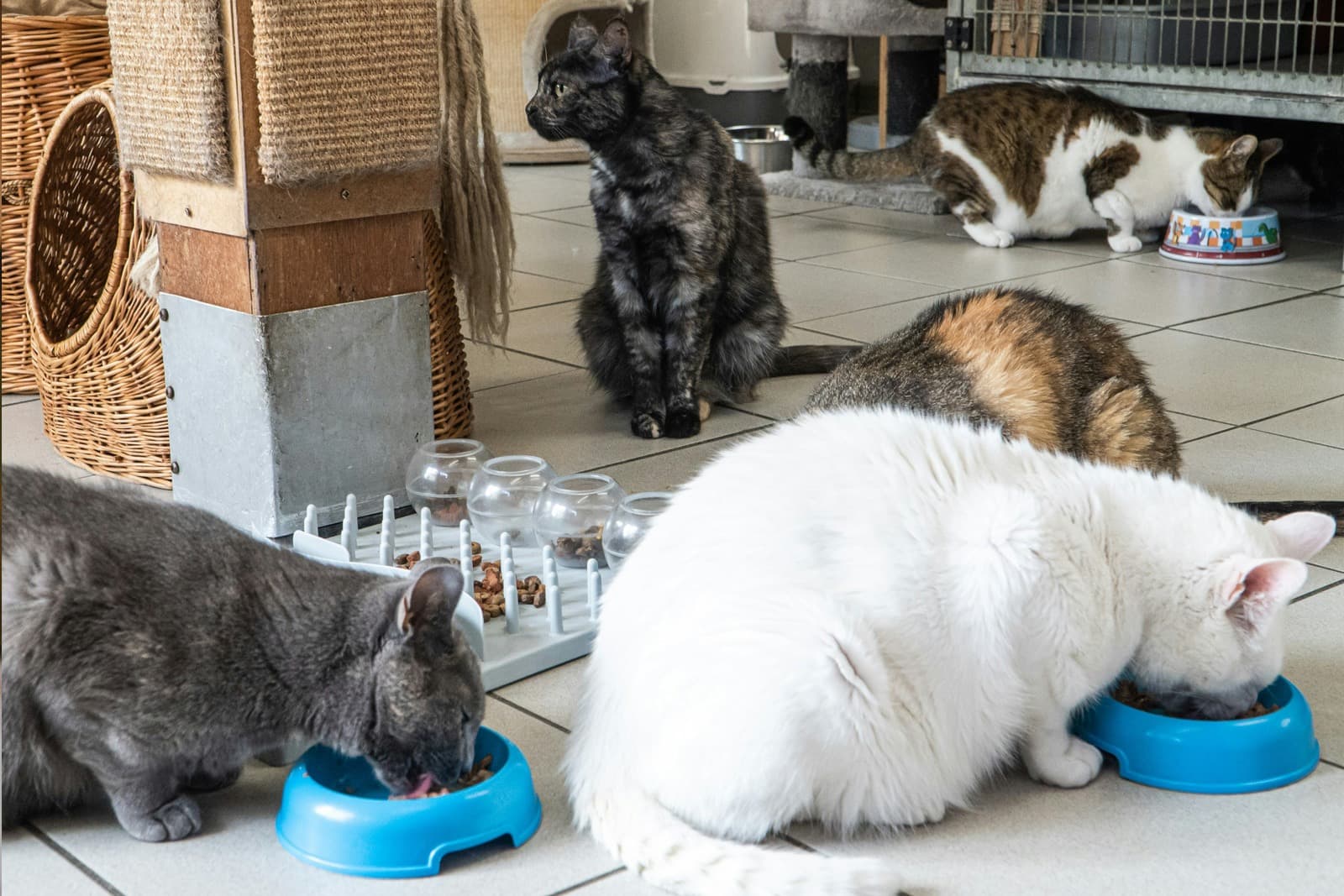
Cats Are Not Pack Animals
One of the foundational facts of cat behavior: domestic cats descended from solitary wild ancestors. Unlike dogs, who evolved from social pack-hunting wolves, cats are physiologically wired for territorial independence. Some cats genuinely enjoy other cats; many simply tolerate them; a small but real percentage cannot live with another cat regardless of effort.
This means multi-cat tension is not a moral failing of any cat. It is a predictable result of putting territorial animals in a shared space. The good news: with the right environment and management, most cats can coexist peacefully.
Signs of Tension
Cat conflict is often subtle. Open fighting (with vocalization, fur flying, injuries) is the obvious end state. Earlier signs include:
- One cat blocking the other from food, water, litter, or favorite spots.
- Hard staring across the room.
- Hiding by one cat, particularly in unusual places.
- Litter box avoidance (often by the lower-ranking cat).
- Increased grooming, especially on one cat.
- Reduced grooming with coat changes (stress-related).
- Increased vocalization or yowling.
- Spraying or marking.
- One cat losing weight; one cat gaining weight (resource access asymmetry).
If you see these signs, intervention works best applied early.
The Resource Math: n+1
The single most important rule in multi-cat households is the n+1 rule: number of cats plus one of every key resource. Two cats need three of each; three cats need four.
| Resource | For 2 cats | For 3 cats |
|---|---|---|
| Litter boxes | 3 | 4 |
| Food bowls | 3 stations | 4 stations |
| Water bowls | 3 stations | 4 stations |
| Scratching posts | 3 | 4 |
| Resting/sleeping areas | 3 (different heights) | 4 |
Critically, resources should be in different rooms or different parts of the house, not lined up next to each other. A cat being blocked from one box has options if there is another in a different location.
Vertical Space
Cats use vertical territory in addition to horizontal. In multi-cat homes, vertical infrastructure is essential:
- Cat trees and shelves at multiple levels.
- Window perches (with views to outside enrichment).
- Doorway-mounted shelves that connect rooms above ground level.
- Top of furniture made accessible — bookcases, refrigerators with safe footing.
Vertical space lets a cat avoid conflict by going up rather than away. It is one of the most effective single interventions for multi-cat tension.
Pheromone Support
Synthetic feline pheromones can reduce stress and conflict in multi-cat homes. Two products are most commonly used:
- Feliway Classic. Synthetic facial pheromone (the kind cats deposit when bunting). Promotes a sense of safety and territory.
- Feliway MultiCat (formerly Feliway Friends). Synthetic appeasing pheromone (the kind mother cats produce to bond kittens). Specifically designed to reduce inter-cat tension.
Diffusers cover roughly 700 square feet each. Effects are modest but well-documented in peer-reviewed studies. Worth trying given the low cost and minimal downside; effective in some cats and not in others.
Hiding Spaces and Escape Routes
Every cat needs places to retreat where other cats cannot follow. Provide:
- Multiple hiding spots in different rooms.
- Cat-only access (cardboard boxes, igloo beds, under-bed spaces).
- Rooms accessible only to specific cats via pet door or owner habit.
- Multiple exits from any room (so a cat cannot be trapped).
The single most reliable predictor of multi-cat household harmony: does each cat always have a clear escape route to a quiet space? If yes, conflict reduces dramatically.
Introducing a New Cat
Most multi-cat tension begins with a rushed introduction. The proper protocol takes weeks, sometimes months.
Phase 1: Separate confinement (3-7 days)
The new cat lives in a separate room with their own litter, food, water, and resting spaces. The existing cat has the rest of the house. They do not see each other but begin smelling each other through the door.
Phase 2: Scent swapping (3-7 days)
Rub a soft cloth on each cat's cheeks (where facial pheromones are produced). Place it in the other cat's space. Switch bedding between rooms periodically. Optionally feed each cat near the door so the other cat's scent becomes paired with food.
Phase 3: Visual contact through barrier (3-14 days)
A baby gate, screen door, or cracked door allows the cats to see each other without contact. Feed both cats at this barrier so meals are paired with the other cat's presence. Watch for relaxed body language before progressing.
Phase 4: Supervised face-to-face (multiple sessions)
Brief, supervised time in the same space. Both cats have escape routes. End sessions before either cat shows stress. Gradually extend duration.
Phase 5: Full integration
Once both cats can share space without tension, integration is complete. Maintain n+1 resources permanently.
Many introductions take 4-8 weeks. Some take months. Rushing the protocol is the #1 cause of multi-cat household failures.
What to Do When Conflict Escalates
If existing cats are fighting:
- Separate immediately. Confine cats to different rooms with their own resources.
- Restart the introduction protocol from Phase 1 if needed. Treat them as new to each other.
- Address resources. Are there enough? In enough locations? Vertical space adequate?
- Add Feliway MultiCat diffusers.
- Consult your vet. Pain in one cat is a hidden cause of inter-cat aggression — sudden conflict between previously friendly cats often reveals an arthritic or sick cat who is now lashing out.
- For severe cases, work with a veterinary behaviorist. Some cats benefit from anxiolytic medication during conflict resolution.
Common Mistakes
- Rushing introductions. The most common single cause of multi-cat household failure.
- Inadequate resources. Two cats sharing one litter box predictably leads to box avoidance.
- Punishing one cat. Cats associate punishment with the human and the situation, not the behavior. Worsens stress.
- Forcing interactions. Picking up cats and bringing them together to get used to it makes things worse.
- Ignoring early signs. Hard staring and resource blocking are the precursors to fighting; intervene then.
Cats Who Cannot Live Together
A small percentage of cats — usually unsocialized adults or cats with severe trauma history — cannot share space with another cat regardless of intervention. Signs that integration is unlikely:
- Persistent serious aggression after months of structured introduction.
- Injuries from fights despite environmental management.
- One cat hiding constantly with no improvement over weeks.
- Resource avoidance that does not resolve with extra resources.
For these cats, separation within the home (different floors, time-shared access to common areas) or rehoming one cat may be the kindest outcome. This is not failure; it is recognition of the cats' actual nature.
Special Cases
Adding a kitten to an adult cat household
Kittens generally integrate more easily than adult cats. The resident adult may show initial irritation but usually adjusts within weeks. Provide the adult with kitten-free zones and protected resting spots; do not force interactions.
Bonded pair adoptions
If you adopt two cats already bonded together, the integration with a resident cat is often easier than adopting a single cat — the bonded pair provides social support to each other during the stressful introduction period.
One indoor and one outdoor cat
Mixing indoor-only and indoor-outdoor cats requires careful management. The outdoor cat brings unfamiliar scents that can trigger stress in the indoor resident.
The Bottom Line
Multi-cat households succeed when the environment respects feline territoriality: ample resources in multiple locations, vertical space, escape routes, and patient introductions. The cat who is not getting along is usually communicating that something specific in the environment is not working. Add the right resource, place it in the right location, and most multi-cat tension dissolves over weeks of patient work.
For severe or persistent behavioral concerns, consult a certified dog trainer or veterinary behaviorist (DACVB).
RELATED READING
More from Pet Behavior

Pet Behavior
Separation Anxiety in Dogs: A Complete Guide
Up to 17% of U.S. dogs suffer from separation anxiety — a clinical panic disorder that produces real distress, real damage, and real suffering. Here is how to tell true separation anxiety from boredom, the evidence-based treatment plan, and when medication makes sense.
2026-05-08

Pet Behavior
Understanding Dog Body Language
Most dog bites in the U.S. could have been prevented if the human noticed earlier signals. Learn to read the full conversation — tail, ears, eyes, mouth, posture — including the famous Ladder of Aggression and the calming signals dogs use to defuse stress.
2026-05-07
Pet Behavior
Cat Body Language: A Complete Tail, Ear, and Eye Guide
Cats communicate as much as dogs do, but their signals are subtler and easier to miss. Here is the complete guide to reading your cat's tail, ears, eyes, whiskers, and posture — and what each combination tells you about how they actually feel.
2026-05-05